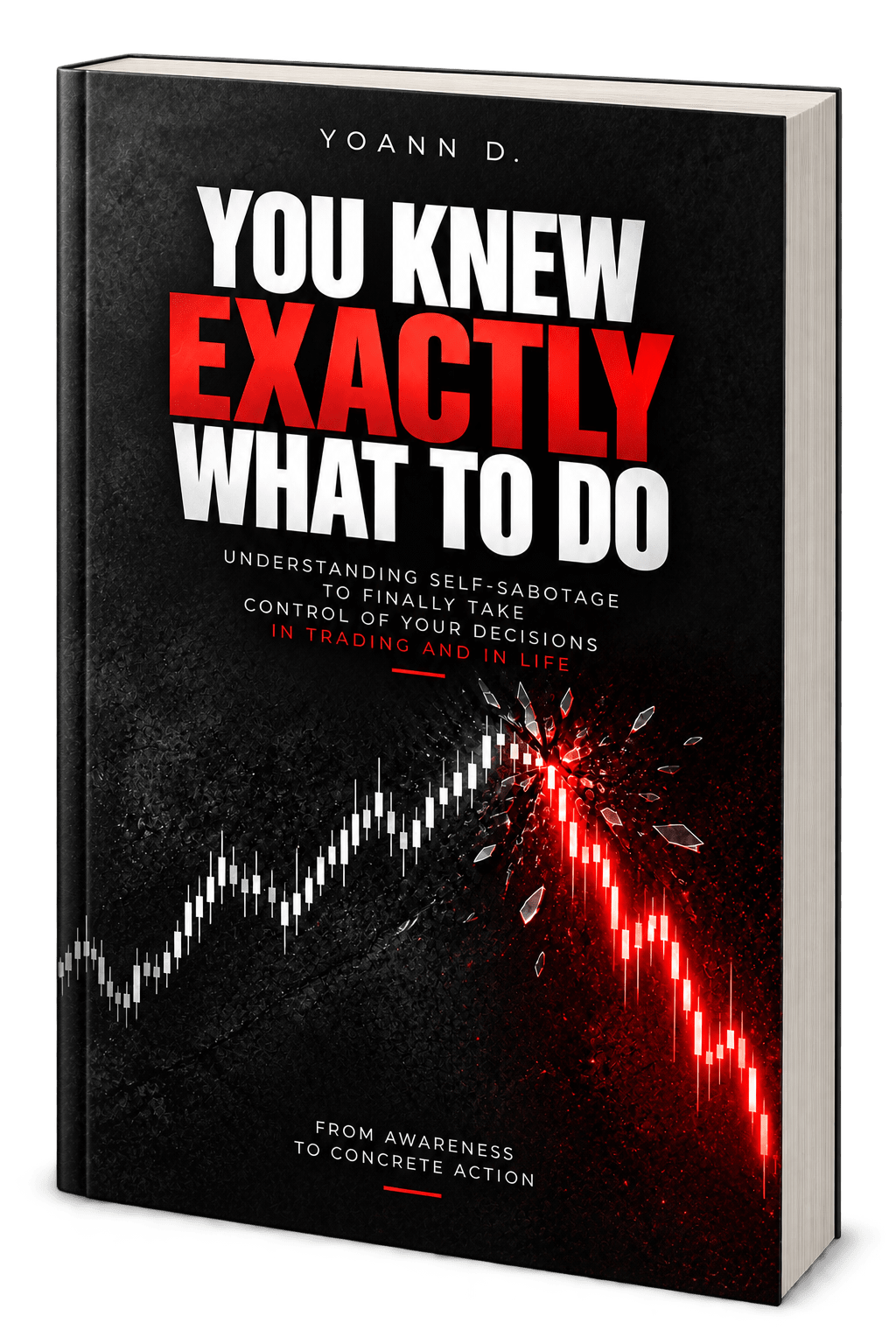
You knew exactly what to do. You clicked anyway.
You knew the setup. You knew your stop. You calculated the risk. Then money became real — and you became a different trader.
This book is about the gap between knowing and doing: the few seconds when fear, ego, FOMO, frustration or the need to be right quietly takes control of your execution.
The hardest part of trading is not knowing what to do.
It is remaining the same person once money is live.
Before the trade, everything makes sense.
Your risk is calculated. Your invalidation is clear. Your position size is defined. You are rational, patient and detached.
Then you click.
Price moves against you. Your P&L turns red. Your body reacts. And suddenly the plan that looked obvious thirty seconds ago begins to feel negotiable.
So you move the stop.
Or you add size. Or close the winner too early. Or jump into another trade because you need the money back.
You did not suddenly forget how trading works.
Something else took control of the decision.
You do not need another indicator to understand why you moved your stop. You need to understand who moved it.
Who takes your mouse when money becomes real?
Self-sabotage rarely feels like self-sabotage while it is happening. Under pressure, the same behavioral patterns tend to appear again and again.
The Hunter
Chases movement because missing the trade feels worse than taking a bad entry.
The Avenger
Turns the next trade into a mission to recover the previous loss.
The Controller
Cannot tolerate uncertainty once unrealized profit appears on the screen.
The Gambler
Needs action even when the market offers no real opportunity.
The Savior
Moves the stop because accepting invalidation feels like accepting defeat.
The Perfectionist
Needs so much certainty that valid opportunities become impossible to execute.
The Chameleon
Changes systems before any strategy has enough time to prove itself.
Understanding the behavior is only the beginning.
The goal is not to become emotionless. It is to build an execution process that does not collapse every time emotion appears.
Recognize your sabotage pattern
Identify the behaviors that repeatedly appear when fear, urgency, ego or frustration enters the trade.
Separate information from discomfort
Learn to distinguish between a market condition that actually changed and an emotional state that simply became uncomfortable.
Build mechanical guardrails
Replace last-second negotiation with predefined rules, constraints and decisions made before pressure arrives.
Redefine a good trade
Separate execution quality from the outcome of one trade instead of allowing P&L to decide whether a decision was good.
Interrupt revenge trading
Understand why the desire to recover a loss can quietly transform risk management into an emotional negotiation.
Protect capital from yourself
Design rules for the trader you become under pressure, not only for the trader who calmly created the plan.
This is not another trading strategy.
If your problem is that you have never learned the basics of trading, this is not a substitute for that education. This book addresses a different problem.
This book will not give you:
This book is for traders who:
Read it your way.
Get the digital edition directly from Yoann Markets or order the physical paperback through Amazon.
eBook — EPUB
Download the digital edition and start reading immediately on your phone, tablet, computer or compatible e-reader.
Paperback
Prefer paper? Order the physical edition directly from Amazon. Pricing and delivery depend on your Amazon marketplace.

Before you read it.
Is this book for beginner traders?
Yes. You do not need advanced technical knowledge to understand the behavioral situations discussed in the book. The subject becomes relevant as soon as real money, uncertainty and risk enter your decisions.
Does the book teach a trading strategy?
No. The book focuses on behavior, execution, decision-making and risk discipline rather than providing entry signals or a trading system.
Is this just a book about controlling emotions?
No. The point is not to eliminate emotion. It is to recognize recurring behavioral patterns and translate that awareness into concrete execution rules and guardrails.
Will this book make me profitable?
No book can guarantee trading profitability. This book addresses one specific part of trading: the gap between the rules a trader intends to follow and the decisions they actually make under pressure.
What do I receive when I buy the $9.99 edition?
You receive the digital EPUB edition of You Knew Exactly What To Do. It is intended for reading on compatible e-readers, smartphones, tablets and computers.
Can I buy a physical copy instead?
Yes. The paperback edition is available through Amazon. Use the paperback option above to continue to Amazon.
You knew exactly what to do.
The question is no longer whether you know enough. It is whether the trader who built the plan will still be in control when money becomes real.